
Blog
Choosing Light Colour Temperature: Which Kelvin for Each Room?
A chandelier’s design shapes a room, but so does the colour of the light it produces. The same space can feel more inviting under warm white light and take on a different appearance under cooler light. When choosing lighting, look at the light source’s Kelvin rating as well as the fitting itself.
For living rooms and bedrooms, 2700K–3000K can be a useful starting point. For everyday tasks, you might consider 3500K–4000K. These are starting points rather than fixed rules. Décor, natural light, how the room is used and personal preference all influence the final choice.
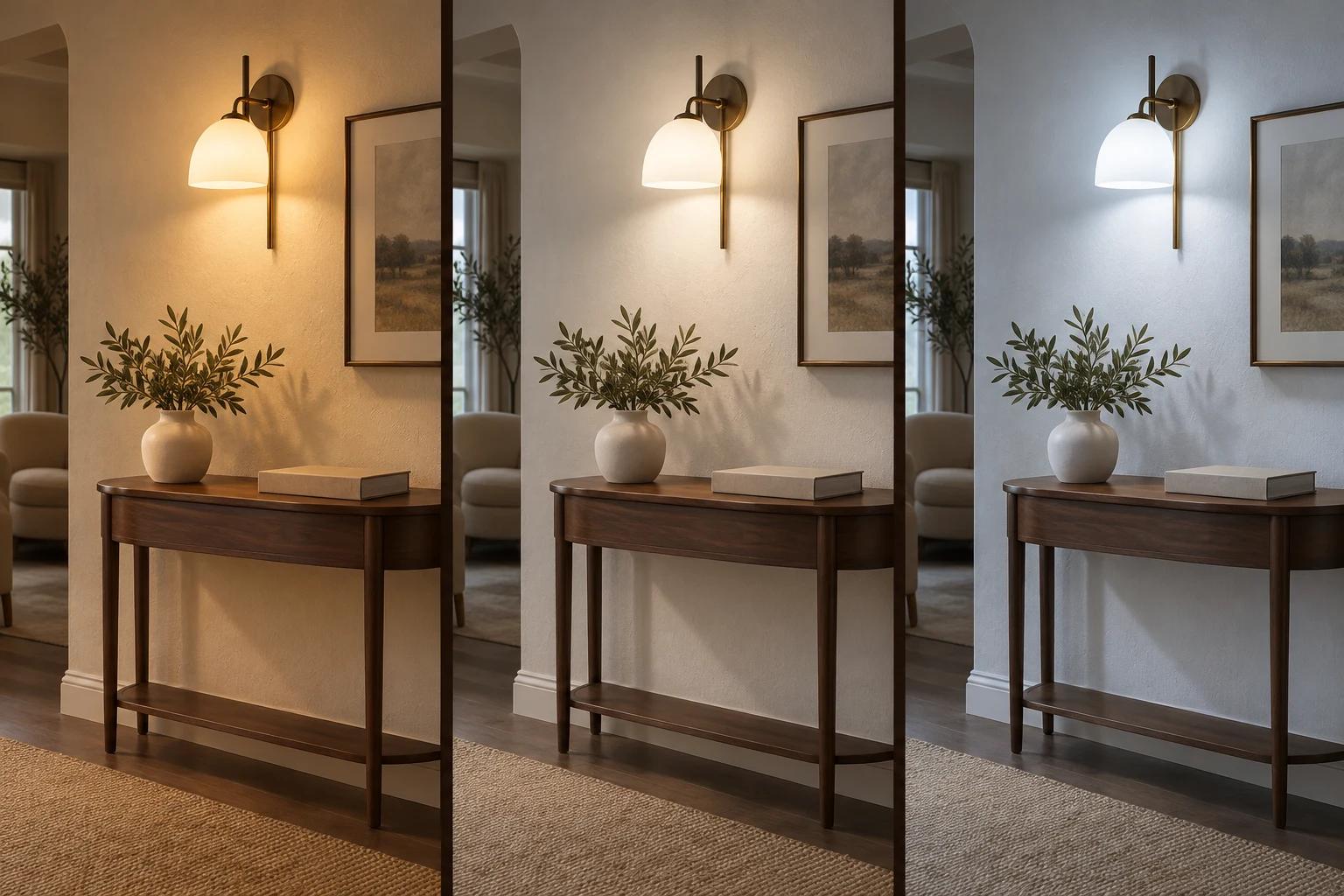
Warm white
Neutral white
Cool white
What is Kelvin, and how does it differ from lumens?
Kelvin (K) is the unit used to describe a light source’s colour temperature. For white light, lower values indicate a warmer, more yellow appearance, while higher values indicate a cooler, more bluish appearance. Product specifications may call this CCT, or correlated colour temperature. It does not tell you how hot the lamp becomes during use. [1]
Kelvin describes light colour; lumens measure the amount of visible light emitted by the source. A higher Kelvin rating therefore does not mean a higher light output. Compare the lumen rating as well as colour temperature when choosing between products. [2]
2700K–3000K: Where does warm white light work well?
Warm white light has a yellowish appearance and can suit spaces used for relaxing and socialising. Consider this range for:
- Living rooms and sitting areas
- Bedrooms
- Lighting above dining tables
- Hotel rooms, restaurants and cafés
- Decorative wall lights and table lamps
2700K has a more noticeably warm appearance, while 3000K looks slightly whiter but remains warm. This range can complement interiors featuring wood, beige and earthy colours.
Consider the chandelier above your dining table together with nearby wall lights. If you want to avoid a strong contrast between lights seen at the same time, comparing similar colour temperatures is a useful starting point.
3500K–4000K: When to consider a more neutral white
This range can suit those who prefer a more neutral or cooler appearance than warm white. Manufacturers may use terms such as “neutral white” and “cool white” differently, so check the Kelvin rating on the packaging.
Spaces where this range may be worth considering include:
- Kitchens and worktops
- Bathrooms and mirror areas
- Studies and offices
- Dressing areas
- General lighting in shops
For example, a kitchen could combine 3000K general lighting with 4000K over a food preparation surface. This is one possible combination, not a requirement. In an open-plan kitchen, consider how the lights look from the adjoining living area. Using one colour temperature throughout may also work well.
5000K–6500K: Cool white and daylight tones
This range produces a cooler white or bluish appearance. Products labelled “daylight” may fall within this range, but the name does not mean they reproduce every quality of natural daylight.
Cool white light may be considered for workshops, garages, storage spaces or particular technical tasks. However, not every workspace needs a high Kelvin rating.
Some people find these tones too cool for relaxing at home. If a room feels underlit, consider light output, the number of fittings and light distribution together, rather than simply choosing a higher colour temperature.
Suggested colour temperatures by room
These ranges are general starting points for choosing lighting. They are not lighting standards or mandatory values for every space.
| Space | Colour temperature to consider as a starting point |
|---|---|
| Living room or sitting area | 2700K–3000K |
| Bedroom | 2700K–3000K |
| Above a dining table | 2700K–3000K |
| General kitchen lighting | 3000K–4000K |
| Kitchen worktop | 3500K–4000K |
| Bathroom and mirror area | 3000K–4000K |
| Study or office | 3500K–4000K |
| Restaurant or hotel room | 2700K–3000K |
| Shop | 3000K–4000K, depending on the products and interior concept |
| Workshop or garage | 4000K–6500K, depending on the task |
Is colour temperature enough to choose the right lighting?
Colour temperature is only one part of the decision. The colour rendering index (CRI) is one measure of how accurately a light source renders object colours compared with a reference light. Kelvin describes the appearance of the light itself; CRI relates to the colours of the objects it illuminates. [3]
Around mirrors, above kitchen worktops and in product displays, also consider:
- Does enough light reach the surface where it is needed?
- Does a person or object cast a shadow over the working area?
- Is a visible light source causing glare?
- How do surfaces and objects look under the chosen light?
For help with fitting size and placement, read our article on choosing chandeliers and lighting for your space.
Should you choose 3000K or 4000K?
Start by comparing 3000K if you want a warm atmosphere, and 4000K if you prefer a more neutral, cooler white. Neither is the single right choice for every room. Where possible, compare the lights side by side near colours similar to those in your space.
Will two lights with the same Kelvin rating look identical?
Not necessarily. Products with the same colour temperature can differ in tint and in how they render colours. Where possible, view the light sources you plan to use together before making your choice. [4]
Can you change a chandelier’s light colour later?
It depends on the product. With a fitting that takes replaceable bulbs, you can change the light colour by choosing suitable bulbs. For integrated LED fittings, check the specifications to see whether the colour temperature is fixed or adjustable. Do not assume every model offers colour adjustment.
Choosing lighting in Kyrenia and Nicosia
When exploring chandeliers and pendants or wall lights for your home, consider design, light colour and how the space will be used together.
Contact Rönesans Avize’s Kyrenia and Nicosia stores to ask about a product’s Kelvin rating and light source options. Sharing photos of your room and describing the kind of light you prefer can help you compare the choices.
Source
- [1]U.S. Department of Energy — Purchasing Energy-Efficient Light Bulbs (opens in a new tab) ↑ Back to text
- [2]ENERGY STAR — Learn About Brightness (opens in a new tab) ↑ Back to text
- [3]U.S. Department of Energy — LED Basics (opens in a new tab) ↑ Back to text
- [4]U.S. Department of Energy — Understanding LED Color-Tunable Products (opens in a new tab) ↑ Back to text
More from our blog
Choosing Chandeliers and Lighting for Your Space
When choosing lighting, think about how the model you like will work in your space. Room size, ceiling height, how the room is used and the furniture layout together determine which chandelier or pendant will suit it.
Read the article: Choosing Chandeliers and Lighting for Your Space